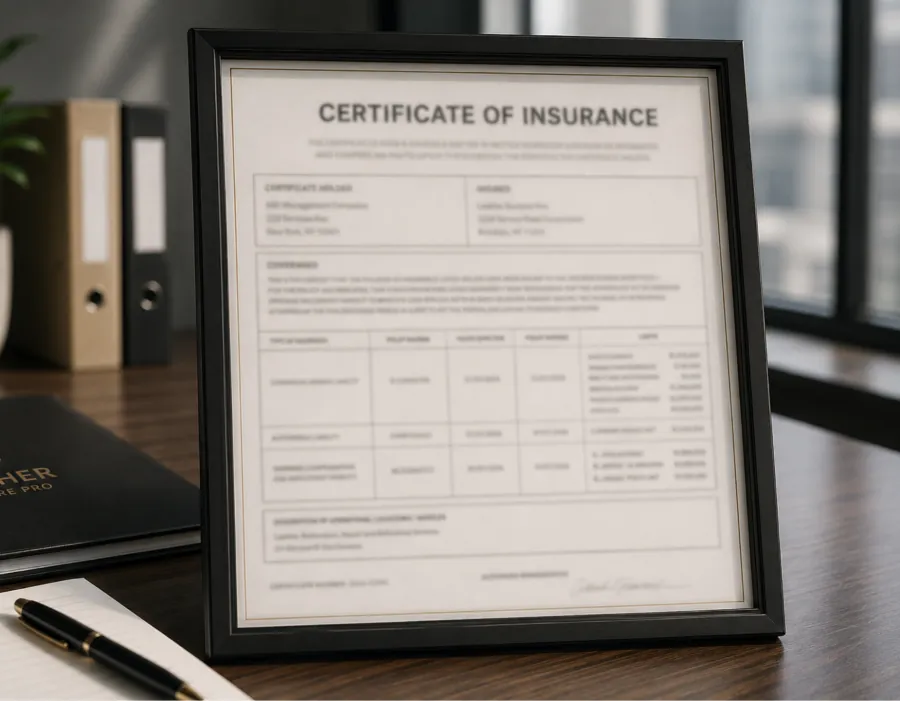

COI Insurance

Licensed and insured furniture repair — certificate of insurance issued for a commercial furniture repair vendor working in a New York City building

Licensed and Insured Furniture Repair

Cleared to start

Licensed and insured furniture repair means three separate things, and a New York managing agent only verifies the third: whether the building, the owner entity and the managing agent are actually named on the policy. Certificates are issued to the requirement written in your own rider, with the endorsements behind them, before a technician is ever scheduled.

Licensed and insured furniture repair

Three words that are not the same thing.Most contractors can claim two of them. Buildings check the third.

Almost every furniture repair company in New York writes “licensed and insured” on its website, and almost all of them mean the first two words only. A managing agent is not reading the phrase. It is reading a one-page form to see whether its own entities appear on it.

Word one

Licensed

A registered business, filed and in good standing, trading under the name that appears on the contract and the invoice. In New York City, upholstery and furniture repair work of this kind is not itself a licensed trade the way electrical or plumbing work is — so the word describes the company, not a permit to touch your seating.

Proves There is a real, filed entity behind the quote, and the name on the certificate can be matched to it.
Does not prove Anything at all about who pays if a solvent bottle goes over on a stone floor.

Word two

Insured

Live policies in force — general liability, workers’ compensation, commercial auto, and excess cover above them. This is the part most contractors do have, and it is genuinely the part that matters if something goes wrong on your floor.

Proves A carrier stands behind the work, and an injured technician is not your problem to absorb.
Does not prove That the cover reaches you. A policy protects its own insured first, and by default only its own insured.

Word three — the one that gets checked

Named

Your building ownership entity, your managing agent and, where the lease says so, your net lessee written onto the certificate as additional insureds, with the endorsement forms actually attached. This is the step that converts our insurance into cover that answers for a claim made against your property.

Proves The building can be defended under our policy rather than starting with its own, which is the whole reason the rider exists.
Where it fails An entity spelled one word differently from the deed. That is a rejected certificate and a lost work window.

A commercial furniture job in a managed New York property almost never fails on craft. It fails at the desk of somebody who has never seen the furniture, reading a form for names.

The certificate

What a managing agent reads, line by line.It is a one-page form, and every box on it is a reason to send you away.

A certificate of insurance is a summary of policies that already exist. It grants nothing on its own — which is exactly why the wording on it is read so closely. Below is the same form your building will receive, field by field, with the failure that sends each one back.

The insured

Who reads itAccounts payable and procurement

Our legal entity, written exactly as it is filed — and exactly as it appears on the proposal, the work order and the invoice that follows. It is the first thing matched against your vendor record.

Bounces whenThe certificate carries a trading name and your system holds the filed name, or the reverse. To a payables clerk those are two different companies.

Certificate holder

Who reads itThe managing agent

The entity the certificate is addressed to. In a managed property this is almost never the name on the awning — it is an ownership LLC, and often a managing agent address rather than the building address.

Bounces whenIt is addressed to the street address instead of the ownership entity, which is the single most common rejection of the lot.

Additional insured

Who reads itThe managing agent and the owner’s broker

The names extended cover under our general liability policy. A tick in the box on the form is a claim about an endorsement; the endorsement itself is a separate document issued by the carrier, and a careful broker asks to see it.

Bounces whenThe box is marked but no endorsement is attached behind it, or the ongoing-operations form is there and the completed-operations form the lease also requires is not.

Description of operations

Who reads itBuilding management and the dock desk

The free-text box, and the one that decides whether the certificate is about your job or about some other job. It carries the property address, the floor or suite, the nature of the work, and the contract or purchase-order reference.

Bounces whenIt is left blank, or it names the building and not the floor — a dock desk cannot tie a blank certificate to the visit on its schedule.

The coverage grid

Who reads itRisk management, or the owner’s broker

The lines in force and the limit carried on each: general liability per occurrence and in the aggregate, auto, workers’ compensation and employer’s liability, and any excess sitting above them. Each is checked line by line against the requirement in your rider.

Bounces whenA limit sits below the figure your rider names — usually because the contractor sent a standard certificate without reading the requirement first.

Effective and expiry dates

Who reads itWhoever files it

Each policy carries its own term, and those terms are set by our renewal calendar, not by your project. The dates have to cover every scheduled visit, including the ones at the far end of a phased job.

Bounces whenThe policy expires partway through the work window. On a multi-visit job the certificate is valid on day one and worthless by the last section.

Waiver and priority wording

Who reads itThe owner’s broker or counsel

Two clauses most institutional leases insist on: a waiver of subrogation, which stops our carrier pursuing your building after paying a claim, and primary and non-contributory wording, which stops your policy being asked to contribute alongside ours.

Bounces whenThe rider requires them and the certificate is silent. Neither is automatic; both have to be endorsed onto the policy and then stated on the form.

Producer and carriers

Who reads itRisk management

The agency that issued the certificate and the carriers standing behind each line. Institutional owners often set a minimum financial-strength rating for an acceptable carrier, and the certificate is where it is checked.

Bounces whenA carrier falls below the rating the rider names, or the producer’s contact details are stale and the building cannot verify the document with a phone call.

Vendor onboarding and insurance paperwork assembled for a commercial furniture repair contractor

Who is named

Getting the name right is most of the job.An entity misspelled by one word is a rejected certificate and a lost work window.

There is rarely only one party to name. A single Manhattan floor can involve an ownership LLC, a net lessee, a managing agent and the tenant whose furniture is being repaired — four entities, four exact spellings, none of which can be guessed from the address.

  • 01

    Building ownership

    The entity that holds the property, almost always an LLC whose name looks nothing like the building everyone calls it by.

    Wording fromThe deed name given in your insurance rider or lease exhibit.

  • 02

    Managing agent

    The firm that actually runs the building and holds the vendor file. It is named separately from ownership, not instead of it.

    Wording fromThe agent’s own certificate request, which usually states it verbatim.

  • 03

    Net lessee

    Where a building is held under a master or net lease, the lessee is a separate insured party. Common in older Manhattan office stock.

    Wording fromThe insurance exhibit attached to the master lease.

  • 04

    Tenant of record

    When the seating sits inside a leased suite, the landlord frequently requires the tenant named alongside itself.

    Wording fromYour own lease, or the alteration agreement covering the work.

  • 05

    Ownership group

    Portfolios that run one vendor file across many addresses name the group rather than repeating the exercise building by building.

    Wording fromThe group’s master vendor requirements — see property & facility programs.

We ask for your insurance requirement before we quote, not after you accept.

The rider is where every one of these names is written down, in the spelling the building will check against. Reading it first is what makes the certificate right the first time — and it occasionally changes the quote, because a requirement above our standing limits has to be arranged rather than assumed. Sending it early costs you nothing and removes the most common reason a start date slips. The rest of the vendor file — W-9, supplier forms, banking, portal setup — is handled through vendor services.

Coverage

The lines a furniture job actually touches.Five coverages, and the specific thing on your floor each one answers for.

Furniture work is not a low-exposure trade. It puts solvents, dyes, adhesives and heat next to carpet, stone, millwork and art, and it puts people on ladders in rooms that other people are still using. Each line below exists for something that genuinely happens.

The principal line

Commercial general liability

Third-party bodily injury and property damage — the line your rider is mostly written about, and the one the additional insured endorsement attaches to. On a furniture job the realistic exposure is not the sofa: it is the floor under it, the wall behind it and the person walking past it. Stripping and refinishing work carries solvent and dye that will mark stone and carpet permanently if they escape, and on-site repairs put all of that inside a finished room rather than in a workshop.

Asked for byEvery managed property, without exception, and named in essentially every commercial lease rider.

Statutory

Workers’ compensation and employer’s liability

Required by statute in both New York and New Jersey for anyone with employees. From the building’s side the exposure is direct and obvious: a technician injured on their floor, in their elevator, on their loading dock.

Asked for byManaging agents, and every institutional owner. Frequently checked before general liability.

On the road

Commercial auto

The vehicles that bring materials in and take pieces out. It matters most on jobs that involve pickup and delivery, where your furniture is off the premises and in transit, and on loading-dock access where the building holds its own vehicle requirements.

Asked for byBuildings with dock scheduling, and any property releasing furniture into our custody.

Above the primary

Umbrella and excess liability

Sits over the general liability and auto lines and lifts the total available limit. This is the line that answers a rider demanding more than a primary policy carries — and the reason a high requirement is usually satisfiable rather than a dead end.

Asked for byClass A office towers, hospitality groups and institutional landlords with high stated requirements.

New York specific

Disability benefits and paid family leave

A New York State requirement that sits alongside workers’ compensation, evidenced on its own form rather than on the certificate. Many New York City managing agents ask for it in the same breath as the compensation policy, and a vendor file is not accepted without it.

Asked for byNew York City managing agents and municipal or institutional procurement.

We do not publish our limits, and you should be wary of a contractor who does.

A limit means nothing in the abstract; it only means something against the figure your rider requires. So the sequence runs the other way round here. You send the requirement, we confirm in writing that each line meets or exceeds it — arranging additional cover where a specification calls for it — and the certificate is then issued to that requirement rather than to a house template. If a requirement genuinely cannot be met, you are told before the quote, not after the crew is booked.

Rejections

Eight reasons a certificate comes back.None of them are about insurance. All of them are about how the form was filled in.

Every one of these is a real rejection, and every one of them costs the same thing: a re-issue, a re-file, and a start date that moves. They are listed here because the fastest way to avoid them is for both sides to know what the reviewer is looking for.

01

The holder is named wrong

Addressed to the building by its street name when the deed says a numbered owner LLC, or issued to the property when it should be issued to the managing agent at its own address.

Avoided by Taking the holder line verbatim from the rider or the agent’s request form, and never retyping it from an email signature.

02

The additional insured list is short

Ownership named, managing agent missing. Or both named and the net lessee — which only appears in the lease exhibit — left off entirely.

Avoided by Treating the rider’s list of entities as a checklist, and asking outright whether the property is held under a net lease.

03

Nothing behind the ticked box

The additional insured box is marked but no endorsement form is attached, so there is no evidence the policy was actually amended. A broker who asks for the form finds nothing.

Avoided by Sending the endorsement forms with the certificate as a matter of course, including completed operations where the lease requires it.

04

Description of operations left blank

A valid certificate that cannot be tied to a job. The dock desk has a visit on its schedule and a document that does not mention the floor, the work or the purchase order.

Avoided by Writing the property address, floor or suite, the nature of the work and the contract reference into the box before it is issued.

05

A limit below the requirement

The consequence of sending a standard certificate without reading the rider first. One line falls short, and the whole document is returned.

Avoided by Reading the requirement before quoting, confirming each line against it in writing, and arranging additional cover where a specification calls for it.

06

The dates do not span the work

Valid on the first visit and expired by the last. Common on phased jobs and on standing maintenance, where the work outlives the policy term.

Avoided by Checking the renewal date against the far end of the schedule, and re-issuing before expiry rather than when somebody notices.

07

Waiver of subrogation not indicated

The lease requires it, the certificate is silent about it. It is not automatic on a policy and cannot be added by writing it into an email.

Avoided by Endorsing it onto the policy where the rider calls for it, then stating it on the certificate so the reviewer can see it.

08

Primary and non-contributory missing

Without it, your own carrier can be asked to contribute to a loss caused by somebody else’s work. Institutional owners never waive this one.

Avoided by Reading the lease exhibit rather than the covering email, since this clause is usually named there and nowhere else.

Renewals

A certificate can expire in the middle of your job.Policies renew on their own anniversary, which is never your project calendar.

A certificate is a snapshot. On a one-visit repair that is fine; on standing work it is the thing everyone forgets until a technician is turned away at a desk. Keeping it current is our administrative job, not yours.

What happens when the policy renews mid-project?

A replacement certificate is issued to the same holder, with the same additional insureds and the same endorsements, and filed with your building before the old one lapses. On a phased job you should never be the one who notices the expiry date — and you should never receive a bare certificate that has quietly dropped the endorsements the first one carried.

What about a portfolio with many buildings?

Each property still needs its own holder and its own named entities, because the entities differ address by address. What does not need repeating is the underlying file: one vendor record, one set of policies, one renewal date, and certificates issued from it per building as they are needed. That is how a property and facility programme runs across a portfolio.

And buildings that want one per visit?

Some do — usually where the description of operations has to name the specific date, floor and work order. It is not a problem and it is not billed for; it is a standing instruction on the account, and the certificate goes out with the visit confirmation. The same applies where emergency work is dispatched at short notice against a pre-approved threshold.

Commercial furniture repair project being planned from the assessment and paperwork stage before work begins

Before the first visit

What has to be true before a technician is on your floor.How commercial furniture repair works from the paperwork end — gates, not stages.

These are not steps in a sequence, they are conditions. Several of them run at the same time, and the job waits on whichever one is still open. Three of the five are cleared on our side, which is deliberate — the administrative load of a commercial job should not land on the person who simply wants the seating fixed.

Gate 01Cleared by us, after the assessment

The scope is written and priced

A technician has seen the furniture, graded it, identified the materials and put the work in writing with a price against it. Blocks: everything downstream — a building will not admit a contractor against a scope nobody has agreed, and procurement cannot raise an order without one.

Gate 02Cleared by your agent or lease

The insurance requirement is in hand

Your rider, insurance exhibit or the managing agent’s own request form, giving the entities to name and the limits to carry. Blocks: the certificate itself. It cannot be issued to names nobody has supplied, and this is the gate that most often turns out to be the slow one.

Gate 03Cleared by us, accepted by the building

The certificate is issued and filed

Requested from our agency against your requirement, checked line by line, sent with its endorsements and confirmed as accepted rather than merely sent. Blocks: physical access. In most managed properties the lobby desk has a list, and a contractor who is not on it does not get past it.

Gate 04Cleared by us, inside your system

Vendor setup is complete

W-9, supplier form, banking details, portal registration and any contractor rules acknowledgement, handled through vendor services. Blocks: payment, and in a good many procurement systems the work order itself, which cannot be raised against a vendor who does not yet exist.

Gate 05Cleared by both sides together

The window is booked

The hours the room is genuinely available, plus dock and freight elevator where the building controls them — whether that is after hours, a single overnight run, or ordinary daytime work in place. Blocks: the crew. Nothing is scheduled against a window that has not been confirmed by whoever controls the space.

A commercial furniture repair project timeline is therefore governed by the slowest gate, not by the repair. The work itself is quantified at the assessment and scheduled around your operation; the paperwork is what decides when that schedule is allowed to begin. The full sequence from assessment through phasing and sign-off is set out on project process.

Questions

What procurement and facilities ask first.

Are you a licensed and insured furniture repair company?

Yes. Licensed and insured furniture repair means three separate things, and all three are in place here: a filed business entity trading under the same name that appears on your contract and invoice; live commercial general liability, workers’ compensation and employer’s liability, commercial auto and excess policies; and — the part a managing agent actually verifies — your ownership entity, managing agent and any net lessee written onto the certificate as additional insureds, with the endorsement forms attached behind them. Certificates are issued to the requirement stated in your own rider rather than from a house template, and filed with the building before the first visit.

Can you name our building and managing agent as additional insured?

Yes, and normally more than those two. A single managed property can require the ownership entity, the managing agent, a net lessee under a master lease and sometimes the tenant of record, each spelled exactly as it appears in the deed or lease exhibit. Send the rider or the agent’s own certificate request and the names are taken from it verbatim — that is what stops the certificate coming back, since a misspelled entity is the most common rejection there is.

How do we get a certificate of insurance from you?

Send us the insurance requirement: the rider, the lease exhibit, or the request form the managing agent uses. We read it, confirm in writing that each coverage line meets or exceeds what it asks for, then request the certificate from our agency made out to the named holder with the endorsements and the description of operations completed. It goes to your building or agent directly, and we confirm it has been accepted rather than assuming it was. There is no charge for any of this and it is not treated as an unusual request.

What if our required limits are higher than the ones you normally carry?

You will be told before the quote rather than after the crew is booked. High stated requirements are common in Class A towers, hospitality groups and institutional portfolios, and they are usually met by the excess or umbrella layer sitting over the primary policies rather than by rewriting them. Where a specification genuinely calls for cover to be arranged, that is done and confirmed in writing first. We do not publish our limits, because a limit only means something measured against your requirement — which is why we ask to read it first.

Do you carry workers’ compensation for technicians working in our building?

Yes. Workers’ compensation and employer’s liability are statutory in both New York and New Jersey, and in New York we also carry the state disability benefits and paid family leave cover that managing agents ask for alongside it, evidenced on its own form. From your side the exposure this answers is direct: a technician injured on your floor, in your elevator or on your loading dock is not something your building should be absorbing.

Our certificate will expire partway through the contract. Do we have to chase you?

No. Policies renew on their own anniversary, which never matches a project calendar, so a replacement certificate is issued to the same holder with the same additional insureds and the same endorsements and filed before the old one lapses. That matters most on phased work and standing maintenance, where the work outlives the policy term and an expired file means a technician turned away at a desk. Watch for the certificate that renews but quietly drops the endorsements the first one carried — that is a real failure mode, and it is checked for here.

What else does procurement usually need besides the certificate?

Typically a W-9, a completed supplier or vendor form in whatever format your system uses, banking details for payment, registration in a procurement portal, and in buildings with their own site rules a signed contractor rules acknowledgement. All of that is handled through vendor services as one exercise, so it is not reassembled at the start of every job. Multi-site portfolios run it once across the whole group rather than building by building.

How does a commercial furniture repair project work, and what does the timeline depend on?

It runs assessment, written scope, access and paperwork, the work window, then sign-off — and the timeline is governed by whichever precondition is still open, not by the repair. The repair itself is quantified at the assessment and scheduled around your operation. What moves a start date is almost always administrative: an insurance requirement not yet supplied, a certificate not yet accepted, or a vendor record not yet created. Those are the gates set out above. The sequence itself, including phasing across a large volume and how sign-off works, is on project process.

Commercial leather lounge seating in a New York City property maintained under an approved vendor agreement

Send the requirement

Send us the insurance requirement. We will read it before we quote.

The rider, the lease exhibit or your managing agent’s own request form — whichever you have. Every entity is taken from it verbatim, every line is confirmed against it in writing, and the certificate is filed with the building before a date is offered. It is the cheapest thing either of us can do to stop a start date moving.

Or call (347) 310-7483 — Manhattan, Brooklyn, Queens, the Bronx, Staten Island, Long Island and New Jersey.

Scroll to Top