Overnight Furniture Repair
Overnight furniture repair is one continuous run on an empty site, worked against a single fixed time — the moment your doors open. Commercial leather, vinyl and fabric seating across New York City is repaired, set, reset and inspected through the closed hours, so the room is complete before the first person walks into it.
The night, backwards
The plan starts at the end.Your opening time is the only part of the night that cannot move, so everything else is scheduled behind it.
A daytime repair runs forwards: arrive, work, finish when it is finished. An overnight repair cannot be run that way, because the finish is fixed before the scope is. So the schedule is built in reverse from the handback, and each stage is given the room the stage behind it needs. Read the six below from the top down and you are walking backwards through the night.
Deadline
Doors open.
The room is complete and in service. Furniture is back on its floor plan, nothing is still wet or curing where anyone can touch it, no equipment or protection is left in the space, and the only evidence of the night is that the seating looks right. This is the fixed point. Everything above it in the schedule exists to protect it.
Before it
Reset, clean down and walk through.
Pieces returned to their exact positions, protection lifted and removed, the area cleaned down, and a walk-through against the photographs taken on arrival so nothing has been left moved or marked. This is the stage that gets squeezed when a night runs late, which is exactly why it is protected first rather than last.
Before that
Set it, then leave it alone.
Adhesive has to hold, finish has to harden and colour has to settle before a seat can take weight or be handled. That time cannot be shortened by working faster, so it is reserved in the plan rather than hoped for. The last part of an overnight job is deliberately quiet, and a night that has no quiet part in it was scoped wrong.
Before that
The repair itself.
Seams opened and restitched, splits and tears closed, panels replaced, foam and webbing renewed, colour corrected and finish rebuilt — whatever the assessment scoped, done in the order that puts the longest-drying work first. Most of it happens without the piece leaving the room; see on-site repairs for what can be done in place.
Before that
Load in and protect.
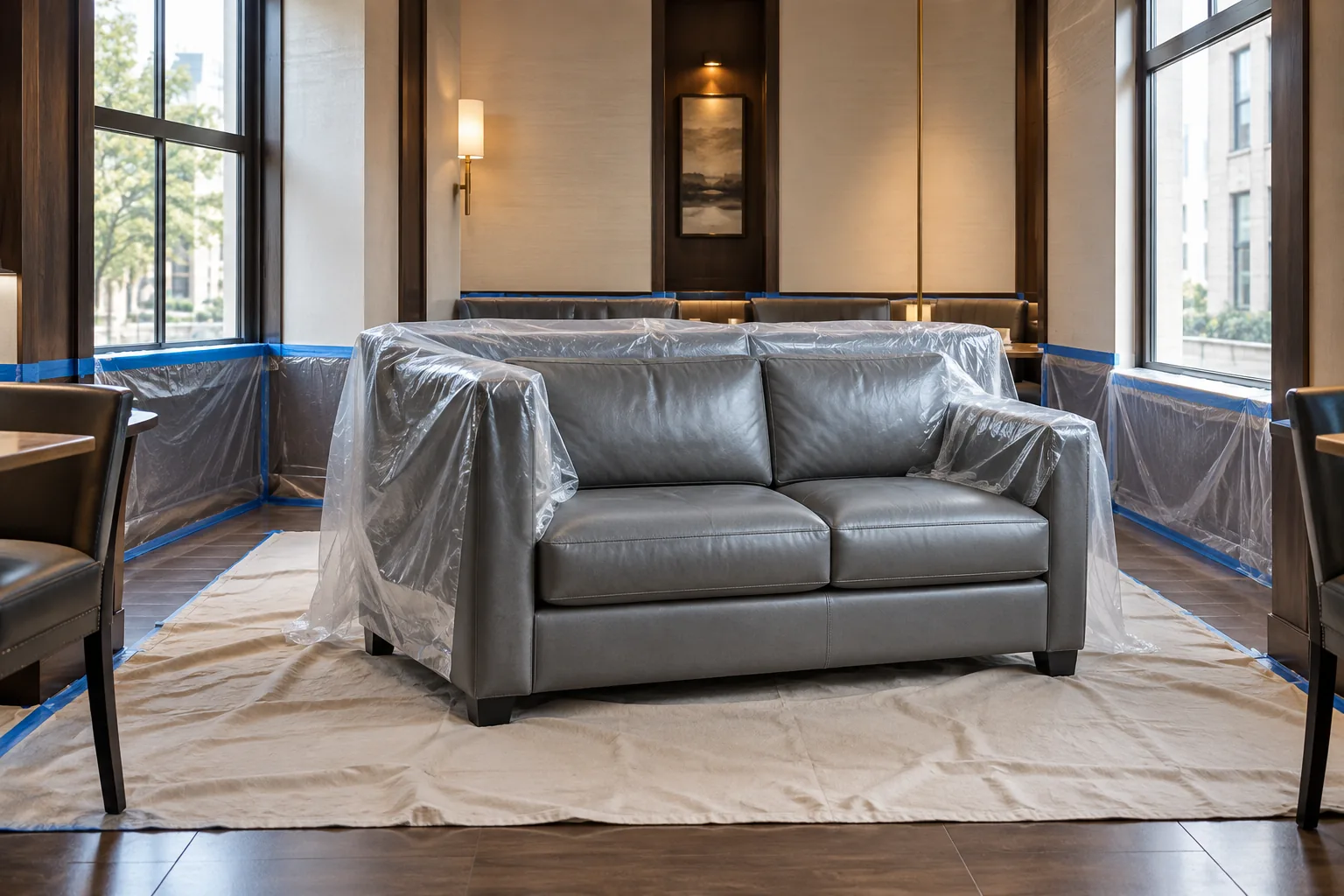
Floors, adjacent seating, carpet and any finished surfaces covered before a tool comes out. On a lobby or a dining room this is not a formality — it is what makes the difference between a room that can be handed back clean and one that needs a cleaning contractor in the morning.
The start
Arrival and survey.
Access confirmed, alarm handled, the affected furniture photographed in place against its floor plan, and the condition found on arrival recorded before anything is opened up. That record is what the morning walk-through is checked against, and it is the same record kept on every job — see project process.
What sets it
The deadline is set by what has to dry, not by the repair.Four things govern how early work has to stop, and whether yours fits a night at all.
Doing the work is rarely the constraint. Waiting for it is. Each of the four below behaves differently in a cold January loading bay and a warm July lobby, which is why the same repair can comfortably fit one room's night and overrun another's. What the assessment produces is not a number of hours but the latest point at which your particular job can still start.
Adhesive and bonding
Takes longer when
The room is cold or damp, the bonded area is large, the backing is non-porous so nothing can breathe out through it, or the joint has to carry load as soon as it is sat on.
Takes less when
The space is warm and dry, the bonded sections are small and local, or the repair can be carried mechanically — stitched, stapled or fixed — instead of relying on the bond alone.
Finish and topcoat
Takes longer when
Several coats are needed to rebuild a worn surface, the sheen is high so every coat has to flash off evenly, or the air is humid. Dust is the other enemy here: anything settling on a wet coat means going back a step.
Takes less when
The existing finish is sound and the work is a matched touch-in over it, or the sheen is matte and forgiving. Fewer coats over a stable surface is the single biggest thing that brings a job inside one night.
Colour and dye
Takes longer when
The shade is being changed rather than restored, or the leather is absorbent — aniline and other unpigmented hides drink colour and need it built in passes, each drying before the next, or the result blotches.
Takes less when
The recolour stays inside the same family on pigmented leather, where the colour sits on a sealed surface rather than soaking into it and only the worn areas need bringing back.
Structure and filling
Takes longer when
A seat platform is rebuilt, webbing is re-tensioned, or a frame has been opened — joints that are glued and clamped cannot be sat on until they have held, and clamps cannot come off early to save the schedule.
Takes less when
Foam and filling are replaced as units cut to size in advance, and the frame is sound. Preparation done off site before the night is the most reliable way to buy back time inside it.
None of this is quoted as a fixed number of hours, and you should be wary of anyone who does. The same repair behaves differently depending on your material, your room and the weather that week. The assessment resolves the four factors above for your job and produces one usable answer: the latest point at which the work can still begin and finish safely. If that point falls before the room can realistically be handed over, the honest answer is that this is not an overnight job — it becomes off-hours work across several visits, where nothing has to be finished by a named morning.
No return
There is a moment after which nothing new gets started.It is fixed at the assessment and written into the schedule before the night begins.
Every overnight job carries the same risk: something is found once a seat is opened that nobody could see beforehand. Handled badly, that is how a room opens with a piece half apart. Handled properly, it is simply a decision that was already made, hours earlier, in writing.
Before the line
Scope can still grow.
If a second panel turns out to be split once the seat is open, or a frame joint is found to have moved, it can be added — because there is still enough night left for the extra work to be done, set and left undisturbed. Anything added here is recorded against the job and confirmed with you afterwards, never invoiced as a surprise.
After the line
Scope is closed, without exception.
Anything discovered from that point is photographed, made safe and left for a scheduled visit — not opened up, not started "quickly". A piece that is half repaired when the doors open is worse than one nobody touched, because it cannot be used and it cannot be hidden. Making that rule absolute is what stops it becoming a judgement call at three in the morning, when every incentive points the wrong way. What is found gets quoted properly and booked properly, usually as off-hours work that is not fighting a deadline.
Empty site
Overnight needs the room to itself.Closed to customers and genuinely empty are two different things, and the difference decides the night.
This is the requirement that most often turns out not to be met, and it is worth checking honestly before a date is agreed. Five things have to be true.
No other trade on the floor
Cleaners polishing, a contractor sanding, anyone cutting or drilling nearby — all of it puts dust into the air, and dust settling on a wet finish is the single most common way an overnight job fails. It does not show until the morning, and by then the coat has to come back off. Overnight work and night cleaning cannot share a floor.
The full run of the affected area
Not one banquette while the rest of the room is in use for a private event. Pieces get moved to be worked on, tools and materials need somewhere to live, and a walkway kept open through the middle of the job costs more time than it saves. If only part of the room can be released, the work is better phased.
Light and power at working level
Night lighting in a lobby is set for atmosphere, not for matching a colour or spotting a missed stitch. Full house lighting for the duration, and outlets that are actually live after hours rather than on a timer that cuts at midnight, both need confirming in advance.
One contact reachable all night
Someone who can be woken if a decision is genuinely needed, who knows the alarm is disarmed, and who can authorise the small things — a door, a lift, a light. On an overnight job this matters more than on an evening visit, because there is no option to pause and pick it up tomorrow.
A certificate already on file
Managed buildings will not release a floor overnight to a vendor whose insurance is not already lodged and naming the correct entity, and none of that can be arranged at eleven at night. It is the most common reason a booked night does not happen. COI and insurance.
If the room cannot be handed over clear — a lobby that never closes, a building with night cleaning it cannot move, a venue with an event running late — the work does not stop being possible. It stops being overnight. It gets phased instead, a section at a time around whatever else is happening, which is off-hours service.
One night
What finishes in a night, and what does not.Said plainly here, because the expensive place to discover the answer is at six in the morning.
Scope, not size, is what decides this. A long banquette run of simple repairs is a better overnight candidate than a single armchair that needs stripping back to the frame. The verdicts below are the usual answer for a normally accessible room; your assessment gives the real one.
Fits a night
Seam, stitch and split repair on seating in place
Opened seams restitched, splits closed and supported, small tears repaired and blended. Localised, mechanically held rather than waiting on a bond across a large area, and the work that overnight suits best.
Fits a night
Panel replacement on a booth or banquette run
Worn or damaged panels cut out and replaced with matched material. Predictable, repetitive across a run, and largely mechanical — the constraint is the material being right, which is settled long before the night. See material matching.
Fits a night
Reupholstery carried out in place on fixed booths and banquettes
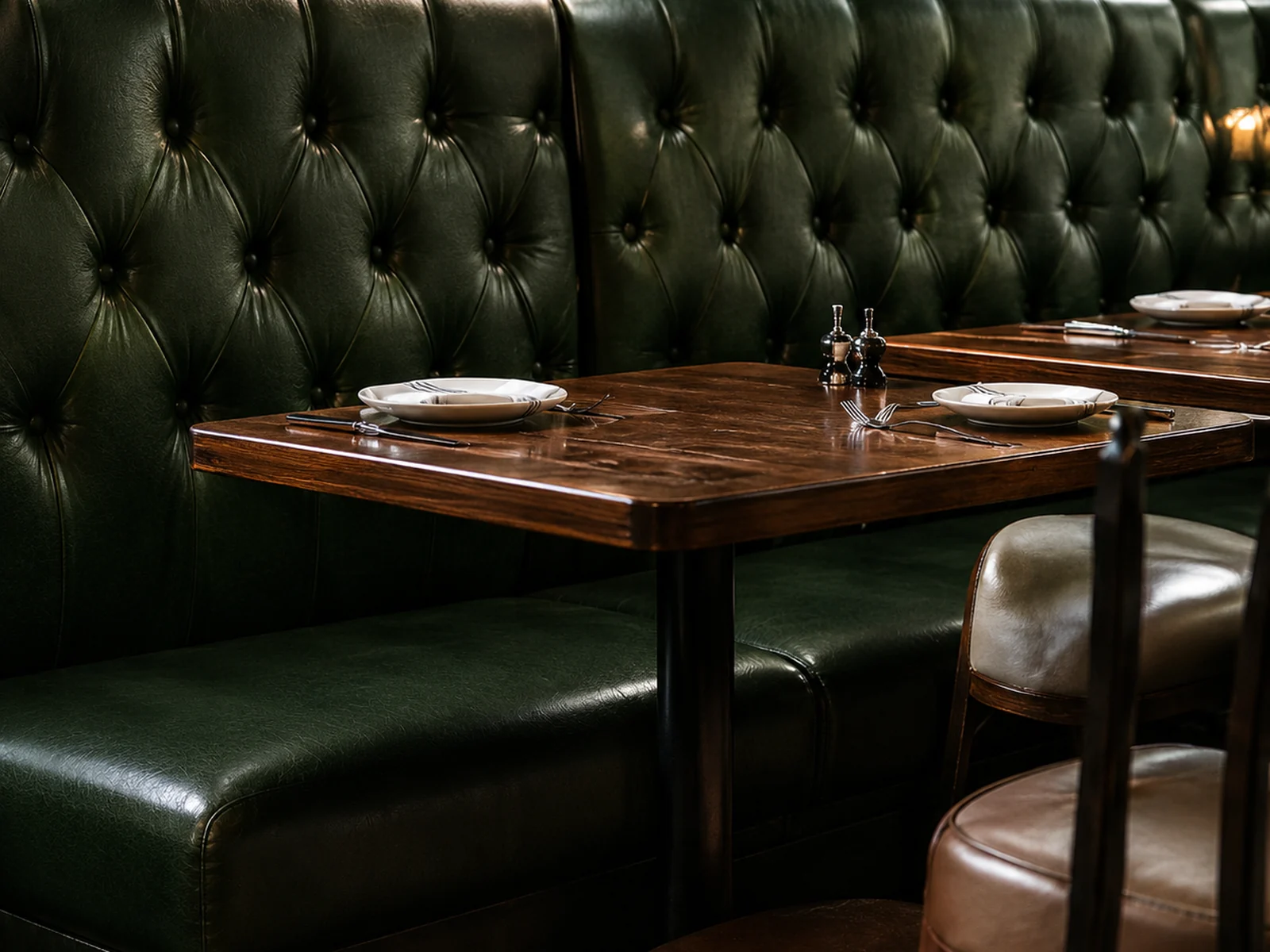
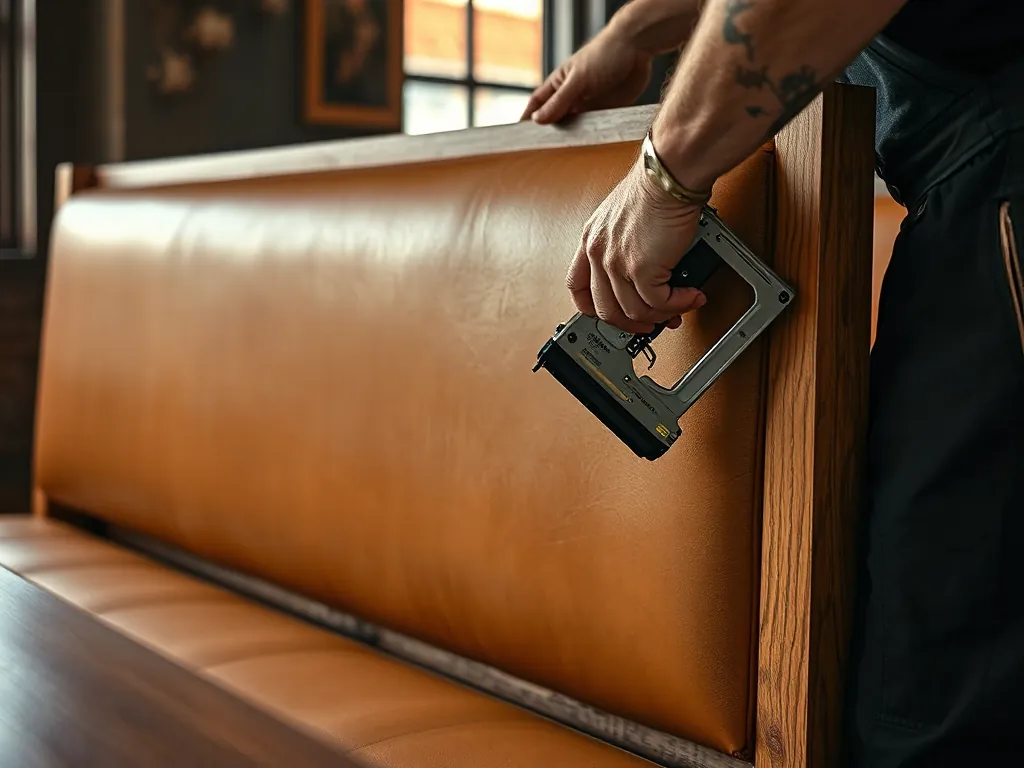
The most common reason a bar or restaurant needs the night at all. Built-in seating cannot leave the building, so it is stripped, re-padded where it needs it and re-covered where it stands. The work is mechanical — stapled and stitched, holding the moment it is fitted rather than waiting on anything to dry — which is exactly why it survives a deadline. It fits when the material is confirmed and the run is templated and cut before the night, not on it. Booked as commercial reupholstery, run overnight.
Usually fits
Colour correction inside the existing shade
Bringing back worn armrests, seat fronts and headrests on pigmented leather where the finish underneath is sound. It fits when it is a correction over a stable surface; it stops fitting the moment the surface has to be rebuilt from further down.
Usually fits
Foam and webbing renewal on seats that have collapsed
Fits comfortably when the replacement units are cut to size in advance and the frame underneath is sound. It stops fitting when opening the seat reveals a frame that also has to be dealt with.
Not one night
Loose seating that has to be stripped back to the frame
Armchairs, tub chairs and sofas needing springs retied and the frame rebuilt underneath are a different job from re-covering a bench. Nothing about them is tied to the room, so there is no advantage to doing them at three in the morning — they are collected and rebuilt properly instead, then brought back. Booked as commercial reupholstery with pickup and delivery.
Not one night
A genuine shade change, or recolouring absorbent leather
Building a new colour evenly takes passes, and each has to dry before the next. On aniline and other unpigmented hides it also has to be given time to settle or it will blotch. The arithmetic does not fit one night, however simple the piece looks.
Not one night
Frame repair, or anything that has to be clamped
Glued and clamped joints have to hold before they carry weight, and the clamps cannot come off early to make a schedule work. Frame work is scheduled where the piece can be left alone properly, which is rarely a room that opens in the morning.
If your job lands in the lower group, nothing is lost — it simply gets booked a different way. Work that needs more time than a night but can stay in the building becomes off-hours service, run across several evenings or a weekend. Work that has to leave becomes pickup and delivery, with the piece collected, worked in the workshop and returned. And if this is a recurring need across a portfolio rather than a one-off, it usually belongs in a maintenance program.
Who books it
Rooms that cannot open late.Overnight is worth its constraints when the opening time is genuinely fixed — and a waste of them when it is not.
If your room could simply open an hour later, or stay one section short for a week, you almost certainly want off-hours service instead and should not pay for a deadline you do not need. These are the places where the deadline is real.
- HotelsA lobby is the first thing every arriving guest sees, and there is no hour of the morning when nobody is checking in or out.Lobby & lounge
- HealthcareWaiting rooms fill from the first appointment, and seating that is out of service means people standing in a room where they should not have to.Waiting areas
- Corporate officesReception floors and client-facing rooms that are booked from the start of the day, where a screened-off section is visible to exactly the wrong people.Reception floors
- Theatres & cinemasA seating house with a matinee has one usable window and a fixed curtain, and a row out of service is a row that cannot be sold.Seating houses
- RestaurantsVenues with a fixed first service — breakfast, brunch or lunch — where the covers lost to a closed section are the whole cost of the repair.Booths & banquettes
- BarsFixed banquettes and built-in bench seating that cannot be taken out to a workshop, in rooms that open again the same evening.Built-in seating
- Property managementResidential lobbies and amenity floors that residents pass through at every hour, where work in progress is the thing that generates the complaints.Lobbies & amenities
Questions
What businesses ask before booking a night.
Do you offer overnight furniture repair for commercial spaces in New York City?
Yes. Overnight furniture repair is how we handle commercial seating in rooms that cannot open late — hotel lobbies, healthcare waiting areas, corporate reception floors, theatres and restaurants with a fixed first service. The crew works a single continuous run on an empty site through the closed hours, and the room is reset, inspected and back in service before the doors open.
Can you reupholster booths and banquettes overnight, on site?
Yes, and it is the most common overnight job we run for bars and restaurants. Built-in seating is fixed to the room and cannot go to a workshop, so it is stripped, re-padded where needed and re-covered where it stands. Reupholstery is mechanical work — stapled and stitched rather than waiting on anything to dry — so it holds as soon as it is fitted, which is what makes it survive a fixed deadline. The material is confirmed and the run templated and cut beforehand, so the night is fitting rather than deciding.
What is the difference between overnight service and off-hours service?
Overnight service is bought for a deadline: one continuous run on an empty site, with the furniture back in use by opening. Off-hours service is bought for a schedule — the work is fitted into the gaps in your normal week, an evening, an early morning, a Sunday, and a job can run across several of those visits while the building carries on around it. If nothing has to be finished by a named morning, off-hours is the less constrained way to buy the same work.
How do you know the work will be finished before we open?
Because the plan is built backwards from your opening time rather than forwards from the start. The assessment establishes what has to cure and therefore the latest point at which the work can still begin, and the schedule is written from the handback back through reset, cure, work and load-in. If the night is not long enough for the scope, that is established before anything is booked rather than discovered at six in the morning.
What happens if you find more damage in the middle of the night?
It depends which side of the point of no return it is found on. Before that line the scope can still grow, because there is enough night left for anything added to be repaired, set and left undisturbed. After it the scope is closed: the damage is photographed, made safe and left for a scheduled visit. A piece left half open at opening time is worse than one nobody touched, so the rule is absolute rather than a judgement call made at three in the morning.
Can leather be recoloured overnight?
A matched recolour within the same shade family on pigmented leather usually can, because it is a thin correction over a sound existing finish. A genuine shade change is a different proposition: it needs several passes to build depth evenly, each drying before the next, and on absorbent leathers such as aniline it also has to be given time to settle or it blotches. That normally exceeds a single night, so it is scheduled as off-hours work across visits, or the piece leaves the building.
Does the building have to be completely empty?
The affected area does, and so does the floor it sits on. Closed to customers is not the same as empty. Cleaners polishing a floor nearby, another trade cutting or sanding, or a corridor still in use will put dust into wet finish, and that is the most common way an overnight job fails. If the room cannot be handed over clear, the work belongs in off-hours service instead, where it is phased around whatever else the building is doing.
Related capabilities
What else decides how the work gets done.
- 01Off-hours serviceWhen there is no deadline, only a closed room
- 02On-site repairsWhat can be done without removal
- 03Pickup & deliveryWhen the piece has to leave the building
- 04COI & insuranceGetting approved for the floor
- 05Project processAssessment, scope, schedule, sign-off
- 06All capabilitiesThe full nine
Book the night
Tell us what time you open. We will build the night backwards from it.
An assessment establishes the scope, resolves what has to cure and produces the latest point at which the work can still start — in writing, before a date is agreed. If the answer turns out to be that your job does not fit a night, the quote will say so and offer the way that does.
Or call (347) 310-7483 — Manhattan, Brooklyn, Queens, the Bronx, Staten Island, Long Island and northern New Jersey.